
Homecoming 2026 | Oct. 15–18
Registration is open! Register by Sept. 21 to receive a FREE Homecoming T-shirt.

An honorary degree is a degree for which Hardin-Simmons University has waived all the usual academic requirements. It is also known by the Latin phrases honoris causa (“for the sake of the honor”) or ad honorem (“to the honor”).
The granting of honorary degrees is a long-standing tradition of universities and is not lightly given. The awarding of honorary degrees should be regarded as a method by which the university expresses its ideals and recognizes outstanding achievements. It provides appropriate recognition by the university for attainment of extraordinary distinction and serves to exemplify the highest purposes and ideals of the university in its recipients. The honorary degree, therefore, represents the highest award given by HSU’s Board of Trustees.
The honorary degree is awarded to recognize an individual for extraordinary accomplishments and achievements that have ongoing and significant importance. A candidate’s special contributions to the purposes and ideals of Hardin-Simmons University specifically may be considered. Consideration may be given to candidates who personify the highest ideals of the university and have notably demonstrated these qualities in their actions and accomplishments.
Throughout the entire process, up to the time of official announcement, the strictest confidentiality must be observed in all cases. All discussion regarding candidates should be limited to current faculty and trustees. The dignity and integrity of the institution and of the candidates should be honored throughout the process.
Under no circumstances should the nominee be informed that his or her name has been put forward. Not all excellent candidates can be recognized, and knowledge of a failed nomination can be embarrassing and harmful.
Further, the nominator should not solicit letters of support on behalf of the nominee from people outside the University. A nomination including letters from outside sources will be disqualified.
The identity of nominators shall not normally be conveyed to the members of the Honorifics Committee.
The candidates to be chosen for eligibility will exemplify Hardin-Simmons University’s values as an institution, unwavering integrity, uncompromising character, Christian witness, and meet AT LEAST TWO criteria as described below.
The Committee is particularly interested in candidates from diverse backgrounds, and those whose accomplishments might serve to highlight areas in which the University has developed exceptional strength.
Please note that the following nominations will NOT be considered:
HSU does not confer Honorary Degrees posthumously or in absentia. Should a candidate not be available, his or her nomination may be carried over to a subsequent year for reconsideration.
Generally, no more than three such degrees may be awarded in any given academic year. If multiple degrees are to be awarded, they can be divided between the two graduations in any way or may be presented at any one ceremony.
Who can make a nomination for an honorary degree?
Nominations may be made by Hardin-Simmons University alumni (graduates and exes), faculty, staff, emeriti faculty, and members of the university’s recognized boards including Boards of Trustees, Development, Alumni Association, and Young Associates.
What is the deadline to submit a nomination?
Nominations can be submitted at any time. Because of procedural considerations, the best time to submit a nomination is no later than May 1 or November 1. Approved nominations will be active for three years from the date of approval by the Committee. Approved nominations will be revisited annually and may be renewed for an additional three-year period.
When are honorary degrees awarded?
The University may award honorary degrees at either of its bi-annual graduation ceremonies. The award of honorary degrees may not necessarily involve a commencement address. A citation will be read by an appropriate university representative, and the recipient may be asked to make a three-minute response.
Characteristics of a Strong Nomination
All nominations shall be seriously considered if accompanied by sufficient and appropriate supporting data.
Successful nominations thoroughly demonstrate how nominees meet the criteria for selection and robustly outline the nominees’ achievements and contributions.
Nominations should include as much biographical and other supporting information as possible, but HSU requires that the nomination process remain confidential and that nominees should not know they are being considered. Therefore, nominees may not be contacted prior to final approval by the Board of Trustees.
The identity of nominators shall not normally be conveyed to the members of the Honorifics Committee.
Submitting a Nomination
Nominations should be submitted through the online Honorary Degree Nomination Form (link below) and should include the following:
1. Summary Statement.
2. Citation Synopsis Draft – one sentence summarizing why the nominee was selected, should the degree be conferred.
3. Candidate’s Curriculum Vitae or similar document list publications or equivalent measures of achievement should be provided.
To ask a question about honorary degrees, please contact us at (325) 670-1377 or honorarydegrees@hsutx.edu.
Who reviews the Nominations?
The Hardin-Simmons University Honorifics Committee is responsible for reviewing all honorary degree nominations. This committee will consist of four Trustees appointed by the Chairman of the Board and three faculty members appointed by the President of the University. The President of the University and the Chairman of the Board will be ex-officio, non-voting members of the committee.
What is the Timing?
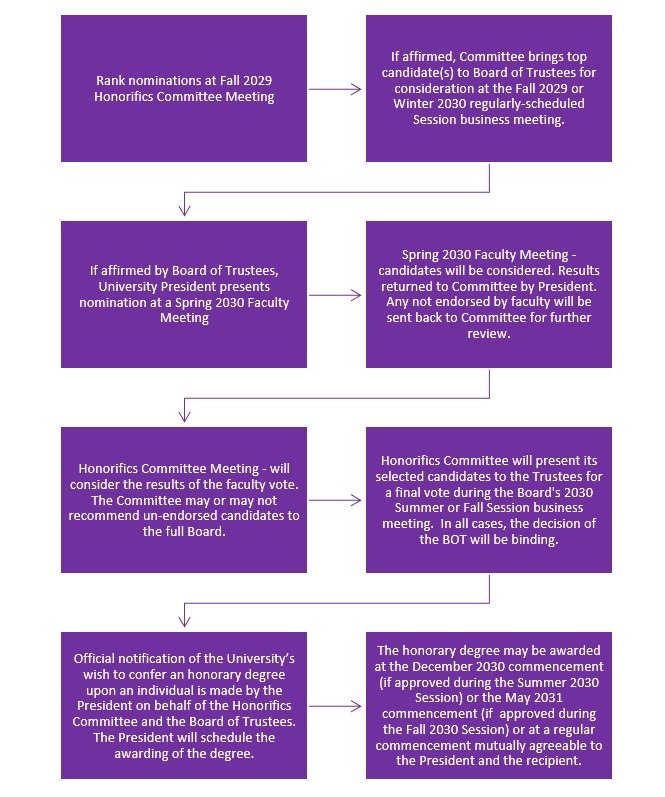
The Committee will meet as appropriate during the Board of Trustees’ regular sessions (and/or at any time during the year). The Committee works 12-16 months in advance of the specific Commencement for which it is making its recommendations.
(refer to provided usage of honorary degree directives)
| DISCIPLINE | CRITERIA |
| Honorary Doctor of XXX | D.XX. h.c. | HSU’s Registrar may adjust the degree format to match current protocols |
| Divinity | Clergy, scholars in the areas of religious studies |
| Engineering and Technology | Engineers/applied scientists/technologists who have achieved high distinction by reason of accomplishing technological innovation, and/or producing transformative applied or basic research while making science useful; and/or exercising exceptional and visionary administrative or institutional leadership in engineering/applied science/technology |
| Arts | Visual Arts: artists with careers in painting, sculpture, drama, architecture, photography, dance, graphic arts, design
Music Arts: performers, conductors, composers | on rare occasions administrators in these areas may be included |
| Humane Letters | Fields related to or of Business | Fields related to or of Education | Persons who have made contributions to society and do not fit other categories |
| Humanities | Scholars in the social sciences or humanities; administrators in related fields |
| Laws | Jurists, legal scholars, diplomats, public statesmen |
| Letters | Writers (fiction, poetry, drama), editors, journalists |
| Science | Scholars in science fields including medicine; health administrators; scholars in biomedical sciences; practitioners of health sciences, natural sciences, formal sciences, applied sciences |
If Nominations received and reviewed throughout the 2028-2029 academic year.
Provided to every honoree upon conference of an honorary degree from Hardin-Simmons University
An honorary degree is an academic degree for which a university (or other degree-awarding institution) has waived all the usual requirements. It is also known by the Latin phrases honoris causa (“for the sake of the honor”) or ad honorem (“to the honor”).
The Hardin-Simmons University policy follows convention in that recipients of honorary doctorates are asked to not use the title “Dr.” in general correspondence, although in formal correspondence from HSU it is normal to address the recipient by the title.
Further, it should always made clear that the degree is honorary by adding “honorary” or “honoris causa” or “h.c.” in parentheses after the degree title or by preceding the degree letters with “Hon.” as in “Hon. DHL.”
Hardin-Simmons requests that such degrees are listed in one’s curriculum vitae (CV) as an award and not in the education section.