The Work That Shapes a Future PT
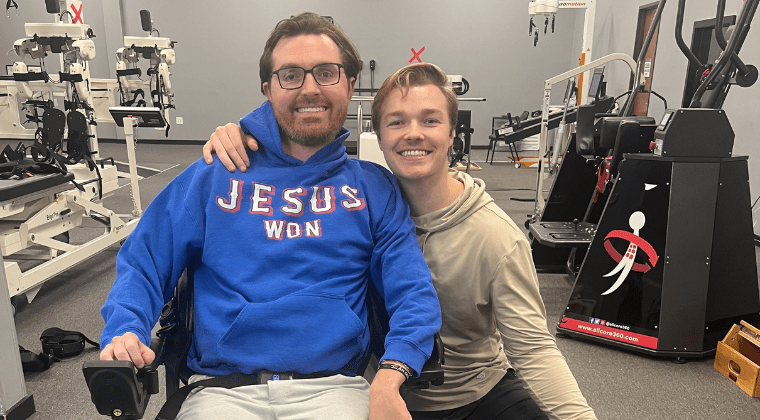
When Jonathan Hoermann walks across the stage next week to receive his doctor of physical therapy degree, he’ll carry far more than a diploma. He’ll bring with him hours spent beside patients relearning how to stand, walk, and move again; experience with some of the most advanced neurorehabilitation technology available; and a clear sense of the kind of Christ-centered therapist he wants to become.
His journey led him from his hometown of Fredericksburg, Texas, to Texas A&M University, and ultimately to Hardin-Simmons University’s Doctor of Physical Therapy program, where rigorous academics, hands-on labs, and a deeply supportive faculty prepared him for one of the most formative experiences of his training: a neuro-based clinical rotation at the Neurological Recovery Center in Fort Worth.
The Neurological Recovery Center is a highly specialized outpatient facility that serves patients with spinal cord injuries, traumatic brain injuries, strokes, multiple sclerosis, cerebral palsy, and vestibular impairments. It is known for its individualized, one-on-one model of care and its access to advanced robotic rehabilitation systems typically found only in select neuro-focused centers. For Hoermann, the opportunity to train in such an environment was both rare and deeply meaningful.
“We saw six to eight patients each day, but the quality of care was exceptional,” Hoermann says. “Every patient I worked with faced their own unique challenges, yet each demonstrated remarkable strength, perseverance, and courage in their journey.”
Hoermann’s interest in neurological physical therapy deepened during his time at HSU, where service opportunities helped him see the human side of neurological care in powerful ways.

During a Wheels for the World trip to Brazil, HSU Doctor of Physical Therapy student Jonathan Hoermann spent time serving children and families affected by neurological conditions and deepened his passion for physical therapy.
“In Brazil, I worked with Wheels for the World, where we provided more than 300 wheelchairs to individuals with neurological conditions,” he recalls. “I also volunteered at Joni and Friends Family Camp, where I was paired with a buddy and their family for the week. Those experiences opened my eyes to the strength and perseverance of people living with neurological diagnoses. That’s when I realized I wanted to understand how physical therapy could help them regain independence and improve their daily lives.”
That calling took on greater clarity in HSU’s classrooms and labs, where professors like Dr. Anemaet and Dr. Robinson challenged him to think critically, approach each case holistically, and recognize the person behind every clinical presentation. His Neuroscience and Neurological Recovery courses laid a strong technical foundation, while hands-on labs and case-based training gave him practical tools he would rely on from his first day in the clinic.
“A typical day was a mix of hard work, creativity, joy, celebrating small victories, and encouraging patients through challenges,” he recalls.
Hourlong sessions allowed him to build meaningful relationships and tailor treatment to each individual’s needs. More importantly, he learned the rhythms of neurological recovery—slow, nonlinear, and full of both breakthroughs and setbacks.
“Neurological recovery doesn’t follow a predictable timeline,” he says. “I discovered that when I remain patient and fully engaged—listening carefully, offering encouragement, and celebrating even the smallest victories—I can help create an environment where trust and hope flourish. Healing is not only about physical progress; it’s about restoring dignity and confidence throughout the journey.”
Not every DPT student nationwide receives a neuro placement with this level of specialization or access to advanced therapeutic technology. Hoermann’s rotation reflects the strength of HSU’s clinical partnerships, which consistently open doors for students to work in settings that challenge them and stretch their skills.
“Hardin-Simmons gave me both the technical knowledge and the confidence to step into a clinical setting ready to serve,” he says. “The program emphasized hands-on learning, critical thinking, and compassionate care, which prepared me for the challenges of a neuro-based rotation.”
The experience also shaped his professional direction. Hoermann now plans to pursue a career that blends neurological and orthopedic physical therapy, driven by a desire to walk alongside patients in some of the most significant seasons of their lives.
“What motivates me each day is not only the opportunity to help someone regain independence, confidence, and joy, but also the chance to reflect the love of Christ through the care I provide,” he says. “I hope patients feel seen, valued, and supported, knowing that their progress is celebrated.”
He encourages current HSU students to lean fully into the learning process—both in the classroom and in the clinic.
“Approach each patient with genuine compassion. Stay curious, humble, and empathetic,” he says. “The work can feel overwhelming at times, but walking alongside someone in their recovery is incredibly rewarding.”
When he crosses the stage next week, he won’t just be closing a chapter. He’ll be stepping into his career as a therapist shaped by rigorous preparation, grounded in service, and committed to bringing both skill and heart to every patient he meets.
Latest News
Academic Support That Builds Strong Habits
February 6, 2026The transition to college can be overwhelming for students and parents alike. New academic expectations, heavier workloads, and increased independence require strong support systems. At Hardin-Simmons University, the Strategic Learning Initiative (SLI) equips students with the skills, structure, and academic strategies they need to succeed from the start.
Meet Your Student Government Association
January 23, 2026At Hardin-Simmons University, the Student Government Association (SGA) serves as the voice of the student body—advocating for student needs, strengthening campus community, and partnering with university leadership to enhance the student experience. Meet the students serving on this year’s Student Government Association.
2025 December Commencement Awards
December 17, 2025Excellence in the classroom. Leadership in the clinic. Service beyond campus. Meet three Hardin-Simmons University graduates whose academic achievement, faith, and commitment to others earned them the university’s highest honors at winter commencement.