International Day of Women and Girls in Science
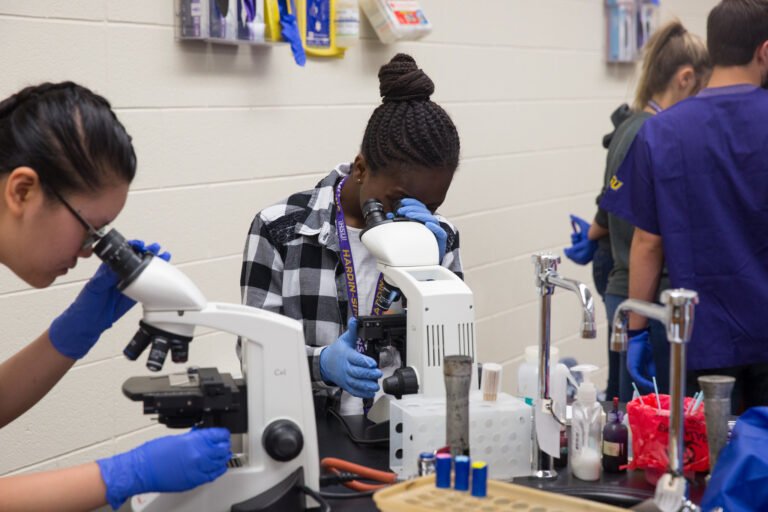
The International Day of Women and Girls in Science was established in 2015 by the United Nations General Assembly to recognize the critical role women and girls play in science and technology. Since then, February 11 is the day women in organizations around the world gather each year to share their experiences in science and technology.
Hardin-Simmons University celebrates women in STEM every day with its faculty and staff, students and alumni, and various academic programs that teach the next generation of scientists, mathematicians, doctors, computer scientists, chemists, and more.
We asked Dr. Wendi Wolfram, Associate Professor of Biology, to share her perspective.
How did you get into your line of work? What drew you to it?
I started out as pre-med in college wanting to become a pediatrician to combine my two loves, children and science. During that time, I was also in the military, cross-trained as a combat engineer and combat medic. During one of our assignments, I had the opportunity to work in a pediatric ward at one of the hospitals. It was a wonderful experience but showed me very quickly that I had trouble separating my emotions from my patients. We had neo-nates on our floor and I was so terrified every time we had to re-stick for an IV. From there, I shifted my focus to general biology until one of my undergraduate professors got me involved in plant research. I designed and conducted my very first scientific research project on acorns and weevils and presented my findings at the Texas Academy of Science winning an award. It was then that I fell in love with fieldwork and research.

Dr. Wendi Wolfram
After I graduated, it was that same professor who encouraged me to get my Master’s degree in environmental science. He then hired me as the university biology lab coordinator with an opportunity to teach biology labs. I have always had an affinity for sharing information with others and I loved getting to work with students and teach them concepts that I was passionate about.
While in my Master’s program, I was influenced by yet another professor. One of our assignments for his class was to develop a research proposal. I had just returned from a volunteer opportunity of working hands-on socializing wolf pups and I was so passionate about my experience that I wrote a proposal focused on the human-wolf conflict and bio-fences. After turning the project in, my professor asked me why I wasn’t getting a Ph.D. with this work. He encouraged me to send my proposal to several universities and one of the graduate faculty at the University of Exeter’s School of Biodiversity and Conservation in England picked up my project. They offered me an opportunity to work with them and earn my Ph.D. in biology. During this time, I was also teaching for the university and found that my love for conservation, wildlife biology, and teaching students were where I was supposed to be. To this day I am still passionate about sharing my love for science, my love for research, and my love for working with living organisms with my students as a faculty member in the Department of Biology.
What is your favorite class to teach and why?
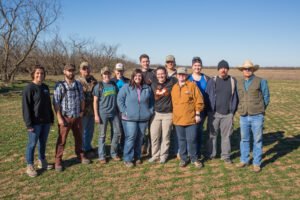
Dr. Wolfram is the Grassland Initiative Program Director and provides students with the opportunity to restore native grassland ecosystems.
My favorite classes to teach are my field and travel courses where I get to take students to places like Minnesota or Alaska to study wildlife. My students have had opportunities to work with the US Geological Survey to track collared wolf packs in the wild as well as track wild moose for population counts. Other students have had the opportunity to help socialize wolf pups for introduction into ambassador packs that facilitate the education of these large carnivores. Students in these classes also observe behaviors in wild black bear populations and, depending on the time of year, get to help prepare food stocks placed in natural corridors for the wild bears as they travel to their hibernation locations. I love teaching these classes because it allows students to experience opportunities they wouldn’t normally get in a classroom setting. It gives them an opportunity to have hands-on experience while also working with leading professionals in various agencies.
What advice do you have for young women pursuing STEM?
There are two pieces of advice that I would share with young women pursuing STEM:
First, instill in your heart, the word “persevere.” Being a woman in STEM means there will be many times you will have to stand up and fight battles for your ideas and your work. Don’t listen to the naysayers. Every STEM field has them. Don’t let anyone tell you that it can’t be done. I don’t know how many times when interviewing research sights to collect data for my Ph.D. that I heard people tell me that my project was a waste of time and it wouldn’t work. The final results speak for themselves but had I listened to the negativity, then the research would have never been completed and the questions would have never been answered.
Don’t get discouraged when others try to de-value your ideas or your work. Stay true to task, complete your work with the highest quality and standard possible. Many times, women in STEM encounter individuals who question and quote obsolete data, trying to diminish the value of the new information out of fear that these findings might somehow undermine their own efforts. Just remember, information changes, that is the beauty of science, as we gain knowledge, and as technology advances, what we once knew can change at the drop of the hat into something more. Be open to that change, don’t stay stuck in the past. I have been approached several times by other scientists who want to use elements of my study in their own work. One of the most recent was a researcher in Africa who reached out and asked to use the chemical ecology from my work to assist in the molecular work on his project. In agreeing to the intellectual collaboration, he may find something new that makes my work obsolete and I am absolutely okay with that. Embrace change. For all I know, my work might be the stepping stone that helps solve a problem in a different way. Value and stand behind your work, yet be open and embrace the changes in your field.
Secondly, don’t ever stop following your passion or your dream no matter how long it takes you to complete it or what obstacles might temporarily block your path. I returned to college to finish my B.S. as a non-traditional student at the age of 27 after having my family. I majored in biology and minored in chemistry. I then went on to pursue and complete my Master of Science degree in environmental management, and finally finished my Ph.D. in biology at the age of 39. If it is a passion, it will always be a part of you and it is never too late to pursue.
If it is a passion, it will always be a part of you and it is never too late to pursue.
Is there research or a project you’re involved with currently?
I have a student who is currently finishing up an honors project working with data comparing the organic compounds found in the urine of coyotes to that of red wolves to determine if there is a correlation that triggers breeding preferences producing hybridization between species. She is presenting her findings at the end of February at the University of Houston-Clear Lake at the Texas Academy of Science Conference and hopes to submit the final research manuscript for publication by April.
Thank you, Dr. Wolfram, for sharing your amazing story!
Are you interested in pursuing a STEM degree at the undergraduate or graduate level? Then, check out our various schools: Holland School of Science and Mathematics | College of Health Professions | Patty Hanks Shelton School of Nursing